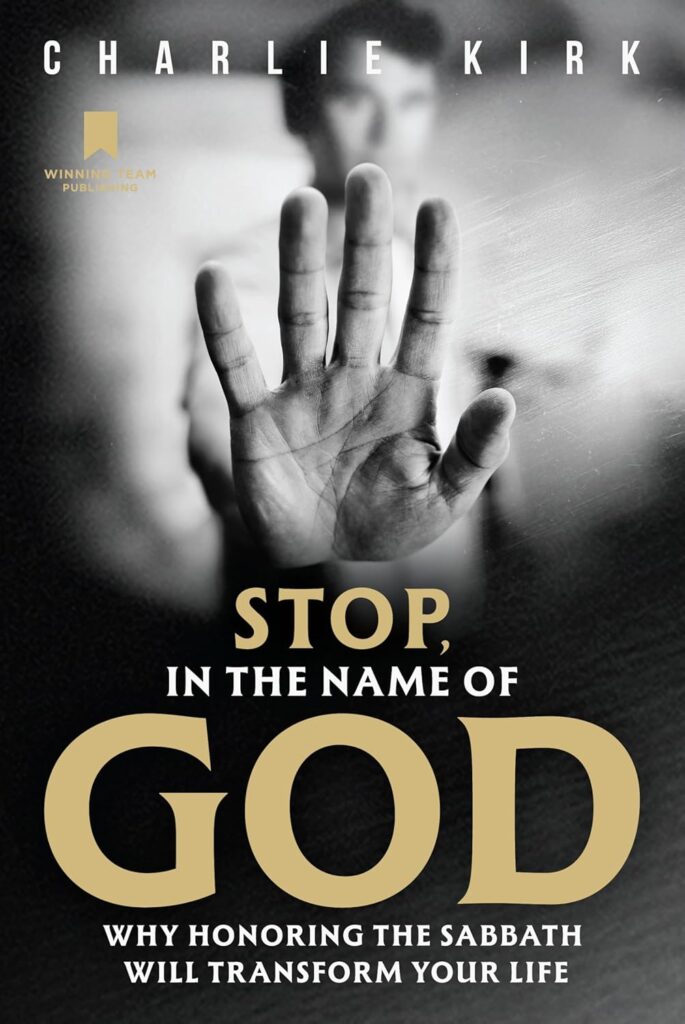
STOP In The Name Of GOD: WHY?
Only after my read of Charlie Kirk’s last book of that name, do I fully grasp the Sunday commandment and why I vow to abstain from unnecessary work or cause others to work on the Lord’s Day.
- Or that the command is less a prohibition and more a magnificent invitation.
- Nor had I understood the radical nature of our Sunday rest from our work.
- Or the reality of God’s sanctification of work.
- Nor did I permit the “day of fire” to permeate all that I do, think, and see.
So when God delivers Israel and gives them the Sabbath, He isn’t just instituting a religious holiday. He is declaring a new identity. You are no longer slaves. You are mine. And because you are mine, you don’t live like the other nations. You don’t grind seven days a week. You don’t build your life on anxiety and exhaustion. You sleep. You breathe. You remember. And in remembering, you resist.
STOP, In the Name of GOD
The Sabbath, then, is a political act. It is a weekly declaration of allegiance-not to Pharoah, not to empire, not to the machine but to Yahweh. You cannot serve two masters. You cannot simultaneously live by grace and by quotas. The Sabbath draws a line. It divides those who are free from those who are in chains.
Within pagan cultures, work was performed only by the poor, slaves, and servants. Until the Lord stepped in to free the Israelites.
“Remember the sabbath day, and keep it holy. Six days you shall labor and do all your work. But the seventh day is a sabbath to the Lord your God; you shall not do any work –you, your son or your daughter, your male or female slave, your livestock, or the alien resident in your towns. For in six days the Lord made heaven and earth, the sea, and all that is in them, but rested the seventh day; therefore the Lord blessed the sabbath day and consecrated it.”
Think about that a minute or twenty: the Lord blessed the Sabbath day and consecrated it. Webster defines consecrate as dedicated to a sacred purpose.
Christianity implodes the pagans’ view of work then, and now.
Let’s not forget that even in paradise, Humanity, Adam, was assigned work:
“Let us make human beings in our image, after our likeness. Let them have dominion over the fish of the sea, the birds of the air, the tame animals, all the wild animals, and all the creatures that crawl on the earth…The LORD God then took the man and settled him in the garden of Eden, to cultivate and care for it.”
The Lord of the Universe, Jesus Christ, chose to incarnate as the son of Joseph, a carpenter, learning his stepfather’s craft, thus sanctifying human work, infusing it with dignity. It’s no wonder, then, that the new pagans of ferocious secularism do all they can to eliminate the seven-day work week and obliterate the Shabbat-Sunday reverence and rest.
Protestant Charlie Kirk never refers to Pope John Paul II’s Apostolic Letter, Dies Domini, in his book. But I wonder if, during his extensive study of the Shabbat and the Sunday commandment, Kirk had found it. The similarity of their messages is striking.
In his Apostolic Letter, Pope John Paul expands on Kirk’s “divine pause” button.
”The commandment of the Decalogue by which God decrees the Sabbath observance is formulated in the Book of Exodus in a distinctive way: “Remember the Sabbath day in order to keep it holy” (20:8). And the inspired text goes on to give the reason for this, recalling as it does the work of God: “For in six days the Lord made heaven and earth, the sea, and all that is in them, and rested on the seventh day; therefore the Lord blessed the Sabbath day and made it holy” (v. 11). Before decreeing that something be done, the commandment urges that something be remembered….
…By its nature, the creative act which founds the world is unceasing and God is always at work…The divine rest of the seventh day does not allude to an inactive God, but emphasizes the fullness of what has been accomplished. It speaks, as it were, of God’s lingering before the “very good” work (Gn 1:31) which his hand has wrought, in order to cast upon it a gaze full of joyous delight.
This is a “contemplative” gaze which does not look to new accomplishments but enjoys the beauty of what has already been achieved. It is a gaze which God casts upon all things, but in a special way upon man, the crown of creation. It is a gaze which already discloses something of the nuptial shape of the relationship which God wants to establish with the creature made in his own image, by calling that creature to enter a pact of love. [Italics mine.} This is what God will gradually accomplish, in offering salvation to all humanity through the saving covenant made with Israel and fulfilled in Christ. It will be the Word Incarnate, through the eschatological gift of the Holy Spirit and the configuration of the Church as his Body and Bride, who will extend to all humanity the offer of mercy and the call of the Father’s love.
God created time.
Kirk baldly makes that statement. I had to think about it for a second before I could agree:
“Of course, God created everything.” But the simplicity of those three words casts a light on the concept of time that necessarily leads us to an awareness of our days, the hours of our lives as God-given gifts. And then to a natural desire to offer one day a week back to honor and reverence the Lord of the Sabbath.
The simple declarative style of Kirk’s writing makes the reader blink and ponder, easily imagining the powerful effect he had on his listeners, especially because of his dedication to objectivity. After 250 pages of passionate prose defending the Sabbath, Kirk turns to the Protestant theologians and reformers who declare that Christ abrogated the Sabbath. Citing Martin Luther, Saint Paul, others, Kirk provides the counterarguments to the Sabbath. In short, they assert, a weekly obligation introduces the very legalism that Jesus despised in the Jewish religious leaders. After reading these objections, I understand better the Protestant claim that the Catholic Sunday imperative to celebrate Mass smacks of Old Testament emphasis on the law while dismissing Christ in our midst.
After a week of studying Kirk’s book and Pope John Paul’s writings, I’ve concluded that my Sunday abstinence from work is right but insufficient. Attending Mass for me is no obligation but rather a need: His Body and Blood are real food without which I cannot live. That is no new belief but has been so ever since my conversion to Catholic Christianity, But after reading about this inconceivably engaged young man’s decision to unplug and turn off for his weekly Shabbat, so will I, in reverence and gratitude.
Sunday, explains Pope John Paul, is the day of Christ, of light.
“Sunday, the day of light, could also be called the day of “fire”, in reference to the Holy Spirit. The light of Christ is intimately linked to the “fire” of the Spirit, and the two images together reveal the meaning of the Christian Sunday.(33) When he appeared to the Apostles on the evening of Easter, Jesus breathed upon them and said: “Receive the Holy Spirit. If you forgive the sins of any, they are forgiven; if you retain the sins of any, they are retained” (Jn 20:22-23). The outpouring of the Spirit was the great gift of the Risen Lord to his disciples on Easter Sunday. It was again Sunday when, fifty days after the Resurrection, the Spirit descended in power, as “a mighty wind” and “fire” (Acts 2:2-3), upon the Apostles gathered with Mary. Pentecost is not only the founding event of the Church, but is also the mystery which for ever gives life to the Church.(34) Such an event has its own powerful liturgical moment in the annual celebration which concludes “the great Sunday”,(35) but it also remains a part of the deep meaning of every Sunday, because of its intimate bond with the Paschal Mystery. The “weekly Easter” thus becomes, in a sense, the “weekly Pentecost”, when Christians relive the Apostles’ joyful encounter with the Risen Lord and receive the life-giving breath of his Spirit.”
Dies Domini
The statement recalls the year I spent immersed in my imagined early life of Saul of Tarsus, exploring the majesty of the Jewish Shabbat, its rite of circumcision, Mishkan, and our creative partnership with God.
When the time came for the brit, everything was ready. As Shimon and Father lit the Havdalah candle, all conversation ceased, and silence descended like a cloud over the hundreds of people gathered inside and outside the house. Each member of the crowd was well aware that this ritual marked the beginning of the eighth day—the day God taught us how to make light. While God Himself had begun creation with “Let there be light!” we celebrated the eighth day as the human contribution to the creation, marking our creative partnership with the Lord.
As the scripture informs us, Adam and Eve had sinned and were exiled from the Garden, but God’s mercy permitted them to spend an extra day there—Shabbat—before their exile. As that day ended and they faced banishment into the darkness,the Lord showed them how to make light. For that reason, the Mishkan—God’s sanctuary—was created on the eighth day: a space of forty cubits containing the Creator of the Universe.
It was as if I could hear the whispers of my desert-dwelling ancestors as they followed the Sanctuary and Moses, and “brought willing offerings to the Lord, every man and woman whose heart made them willing to bring for all manner of work which the Lord had commanded.”
Abounding with the privilege of my Hebrew faith and rabbinical training, I took my place as the father of the child in front of the table where David lay. I closed my eyes and prayed: And God said unto Abraham: ‘And as for thee, thou shalt keep My covenant, thou, and thy seed after thee throughout their generations. This is My covenant… every male among you shall be circumcised. And ye shall be circumcised in the flesh of your foreskin, and it shall be a token of a covenant betwixt Me and you. And he that is eight days old shall be circumcised among you, every male throughout your generations … And the uncircumcised male who is not circumcised in the flesh of his foreskin shall be cut off from his people; he hath broken My covenant.This day of Pentecost, every Sunday for the rest of our lives, let us rest in Him to surrender, restore, and receive.