
Politicians have a patron saint: It’s a joke, right?
The young couple’s reaction could well be anyones’ in this muddled, politics-soaked early twenty-first century, when told there is indeed such a person: It’s a man from the sixteenth century. On their minds might be two questions:
- Patron saint, isn’t that some kind of relic from the Middle Ages or something?
- How can anyone from five hundred years ago be relevant to our age, historically unmatched in knowledge and technology?
- Indeed, all history is relevant if we take time to look.
It’s next to impossible to miss the parallels between 16th century England and 21st Century America. All that is required is a brief read of the history of King Henry Vlll and Thomas More.
And of lawyers and politcians, then and now.
And of the dark side of the law. My sole experience as a courtroom juror was so distressing and regrettable that I wrote a novel about it. Do You Solemnly Swear: A Nation of Law, The Dark Side is a story of the wrongful conviction of a young man accused of sexually abusing a six-year-old child. Writing the book was the best way I knew to convey the absolute falsity of the legal mantra “presumed innocent until proven guilty.”
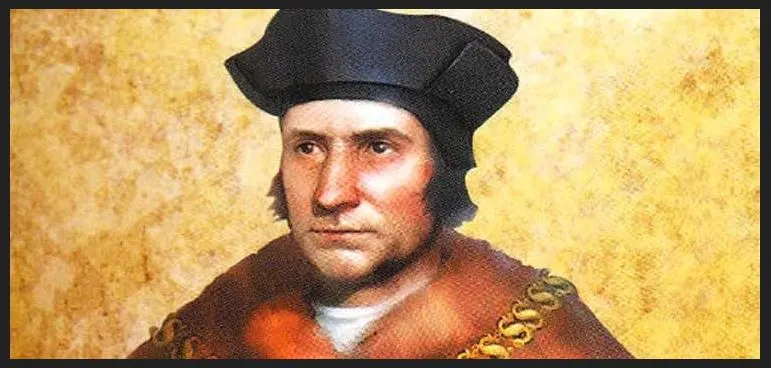
Twenty-six years ago, Pope John Paul listened to “heads of state, governments, countless political figures, Episcopal Conferences, and Bishops” requests to proclaim Saint Thomas More the Patron Saint of Politicians and Statesmen.
The life and martyrdom of Saint Thomas More have been the source of a message which spans the centuries and which speaks to people everywhere of the inalienable dignity of the human conscience, which, as the Second Vatican Council reminds us, is “the most intimate centre and sanctuary of a person, in which he or she is alone with God, whose voice echoes within them” (Gaudium et Spes, 16).
Whenever men or women heed the call of truth, their conscience then guides their actions reliably towards good. Precisely because of the witness which he bore, even at the price of his life, to the primacy of truth over power, Saint Thomas More is venerated as an imperishable example of moral integrity. And even outside the Church, particularly among those with responsibility for the destinies of peoples, he is acknowledged as a source of inspiration for a political system which has as its supreme goal the service of the human person.
Recently, several Heads of State and of Government, numerous political figures, and some Episcopal Conferences and individual Bishops have asked me to proclaim Saint Thomas More the Patron of Statesmen and Politicians. Those supporting this petition include people from different political, cultural and religious allegiances, and this is a sign of the deep and widespread interest in the thought and activity of this outstanding Statesman.
Apostolic Letter Issued Moto Propio
PROCLAIMING SAINT THOMAS MOREPATRON OF STATESMEN AND POLITICIANS
Pope John Paul II in the year 2000.
Tomorrow, June 22, is the Feast Day of Saint Thomas More.
More was Henry VIII’s Lord Chancellor. during King Henry VIII’s failed attempts to annul his first marriage. The marriage to Catherine of Aragon was invalid, claimed the King, for two reasons. It had produced no heirs and secondly a marriage to his brother’s widow was invalid according to Church law. King Henry’s arguments failed. So King Henry declared himself-and successive monarchs- head of the English church through a Parliamentary move called the Act of Supremacy. The legislation proves that purely legal/politically based reasoning devoid of God’s law can justify anything. It was true centuries ago, and in our “historically unmatched in knowledge and technology” days remains true.
Decades ago, in an undergraduate English class, I met Thomas More through the eyes of another atheist, screenwriter Robert Bolt. One of the more successful playwrights of the last century, Bolt wrote the screenplays for Lawrence of Arabia, Dr. Zhivago, and The Mission. But it was A Man For All Seasons for which he was best known. I loved this play, then and still. In fact, in the ensuing decades, I’ve read it another seven, maybe eight times. Unlike the Fitzgerald and the Hemingway novels I’ve returned to, Bolt never disappoints.
Why?
Each read provides new wisdom. His preface is splendid: the author muses out loud about his fascination with More. At times, Bolt is close to apologetic as he explains why a twentieth-century atheist has fallen in love with a sixteenth-century Roman Catholic martyr.
We moderns understand and even sympathize with the king’s imagined personal justifications for his new religion: They read as logical and reasonable.
Henry VIII, who started with everything and squandered it all, who had the physical and mental fortitude to endure a lifetime of gratified greeds, the monstrous baby whom none dared gainsay, is one of the most popular figures in the whole procession. We recognise in him an archetype, one of the champions of our baser nature, and are in him vicariously indulged. Against him stood the whole edifice of medieval religion, founded on piety, but by then as moneyed, elaborate, heaped high and inflexible as those abbey churches which Henry brought down with such a satisfying and disgraceful crash. The collision came about like this: While yet a Prince, Henry did not expect to become a King, for he had an elder brother, Arthur. A marriage was made between this Arthur and a Spanish Princess, Catherine, but Arthur presently died. The Royal Houses of Spain and England wished to repair the connection, and the obvious way to do it was to marry the young widow to Henry, now heir in Arthur’s place. But Spain and England were Christian Monarchies and Christian law forbade a man to marry his brother’s widow. To be a Christian was to be a Churchman and there was only one Church (though plagued with many heresies) and the Pope was its head. At the request of Christian Spain and Christian England the Pope dispensed with the Christian law forbidding a man to marry his brother’s widow, and when in due course Prince Henry ascended the English throne as Henry VIII, Catherine was his Queen…[But years later]
The Pope was once again approached, this time by England only, and asked to declare the marriage with Catherine null, on the grounds that it contravened the Christian law which forbade marriage with a brother’s widow. But England’s insistence that the marriage had been null was now balanced by Spain’s insistence that it hadn’t. And at that moment Spain was well placed to influence the Pope’s deliberations; Rome, where the Pope lived, had been very thoroughly sacked and occupied by Spanish troops. In addition one imagines a natural disinclination on the part of the Pope to have his powers turned on and off like a tap. At all events, after much ceremonious prevarication, while Henry waited with a rising temper, it became clear that so far as the Pope was concerned, the marriage with Catherine would stand.
To the ferment of a lover and the anxieties of a sovereign Henry now added a bad conscience; and a serious matter it was, for him and those about him. The Bible, he found, was perfectly clear on such marriages as he had made with Catherine; they were forbidden. And the threatened penalty was exactly what had befallen him, the failure of male heirs. He was in a state of sin. He had been thrust into a state of sin by his father with the active help of the Pope. And the Pope now proposed to keep him in a state of sin. The man who would do that, it began to seem to Henry, had small claim to being the Vicar of God. And indeed, on looking into the thing really closely, Henry found – what various voices had urged for centuries off and on – that the supposed Pope was no more than an ordinary Bishop, the Bishop of Rome. This made everything clear and everything possible. If the Pope was not a Pope at all but merely a bishop among bishops, then his special powers as Pope did not exist. In particular of course he had no power to dispense with God’s rulings as revealed in Leviticus 18, but equally important, he had no power to appoint other Bishops; and here an ancient quarrel stirred. For if the Pope had not the power to appoint bishops, then who did have, if not the King himself – King by the Grace of God? Henry’s ancestors, all those other Henries, had been absolutely right; the Bishops of Rome, without a shadow of legality, had succeeded over the centuries in setting up a rival reign within the reign, a sort of long drawn usurpation. The very idea of it used to throw him into terrible rages. It should go on no longer. He looked about for a good bishop to appoint to Canterbury, a bishop with no ambitions to modify God’s ruling on deceased brothers’ wives, yet sufficiently spirited to grant a divorce to his sovereign without consulting the Bishop of Rome. The man was to hand in Thomas Cranmer; Catherine was divorced, Anne married, and the Established Church of England was off on its singular way….
To put it another way, more briefly; we no longer have, as past societies have had, any picture of individual Man (Stoic Philosopher, Christian Religious, Rational Gentleman) by which to recognise ourselves. we are anything. But if anything, then nothing, and it is not everyone who can live with that, though it is our true present position. Hence our willingness to locate ourselves from something that is certainly larger than ourselves, the society that contains us. But society can only have as much idea as we have what we are about, for it has only our brains to think with. And the individual who tries to plot his position by reference to our society finds no fixed points, but only the vaunted absence of them, ‘freedom’ and ‘opportunity’; freedom for what, opportunity to do what, is nowhere indicated….
At any rate, Thomas More, as I wrote about him, became for me a man with an adamantine sense of his own self. He knew where he began and left off, what area of himself he could yield to the encroachments of his enemies, and what to the encroachments of those he loved.
Bolt, Robert. A Man For All Seasons (Modern Classics) . Bloomsbury Publishing. Kindle Edition.
More was a man,
who did not race to martyrdom, unlike most of the saints revered by the Church and rejected by Bolt. Quite the contrary, married with four children whom he loved dearly, Thomas More was a lover of life, good food, and fine wines. He was a man of law and a loyal subject of the King of England. He was, however, a humanist; a concept which in the sixteenth century, conveyed submission to God and his law.
More was a man who did not want to die.
The years from 1529 through 1535 were years replete with increasingly desperate attempts at compromise. In 1529, Sir Thomas More was appointed Lord Chancellor of England. Over and over, the statesman sought conciliation- a way to reconcile the rupture between his king and his faith; a way to prevent the schism between the Church and the King. Finally, More persuades King Henry to accept his resignation as Lord Chancellor in hopes that the resignation could serve to recuse him from signing. But the king insisted on total subjugation. In 1535, More was beheaded for his treasonable refusal to sign the Act of Supremacy. The legislation that declared Henry as Supreme Head of the Church of England. And which validated Henry’s annulment from his marriage to Catherine of Aragon.
Conscience of a nation…”come with us for friendship…”
Norfolk: I’m not a scholar, as Master Cromwell never tires of pointing out, and frankly I don’t know whether the marriage was lawful or not. But damn it, Thomas, look at those names… You know those men! Can’t you do what I did, and come with us for friendship?
More: And when we stand before God, and you are sent to Paradise for doing according to your conscience, and I am damned for not doing according to mine, will you come with me, for friendship?
Cranmer: So those of us whose names are there are damned, Sir Thomas?
More: I don’t know, Your Grace. I have no window to look into another man’s conscience. I condemn no one.
Cranmer: Then the matter is capable of question?
More: Certainly.
Cranmer: But that you owe obedience to your King is not capable of question. So weigh a doubt against a certainty — and sign.
More: Some men think the Earth is round, others think it flat; it is a matter capable of question. But if it is flat, will the King’s command make it round? And if it is round, will the King’s command flatten it? No, I will not sign.
It’s no joke
I began this piece sardonically because of the years I spent ridiculing people like the one I have become: devoutly prolife, orthodox, and certain of my sinfulness. Therefore, Pope John Paul’s decision to provide a heavenly beacon for statesmen and politicians is far from a joke. Rather, it makes my heart soar. I am confident that Saint Thomas More heard and understood my twenty-something self’s yearning for Someone I loved, no adored, so much that I’d die for Him. Perhaps he even intervened for the grace of my conversion.
Although I know well, Margaret, that because of my past wickedness I deserve to be abandoned by God, I cannot but trust in his merciful goodness. His grace has strengthened me until now and made me content to lose goods, land, and life as well, rather than to swear against my conscience.
God’s grace has given the king a gracious frame of mind toward me, so that as yet he has taken from me nothing but my liberty. In doing this His Majesty has done me such great good with respect to spiritual profit that I trust that among all the great benefits he has heaped so abundantly upon me I count my imprisonment the very greatest. I cannot, therefore, mistrust the grace of God. By the merits of his bitter passion joined to mine and far surpassing in merit for me all that I can suffer myself, his bounteous goodness shall release me from the pains of purgatory and shall increase my reward in heaven besides.
I will not mistrust him, Meg, though I shall feel myself weakening and on the verge of being overcome with fear. I shall remember how Saint Peter at a blast of wind began to sink because of his lack of faith, and I shall do as he did: call upon Christ and pray to him for help. And then I trust he shall place his holy hand on me and in the stormy seas hold me up from drowning.
And finally, Margaret, I know this well: that without my fault he will not let me be lost. I shall, therefore, with good hope commit myself wholly to him. And if he permits me to perish for my faults, then I shall serve as praise for his justice. But in good faith, Meg, I trust that his tender pity shall keep my poor soul safe and make me commend his mercy.
And, therefore, my own good daughter, do not let your mind be troubled over anything that shall happen to me in this world. Nothing can come but what God wills. And I am very sure that whatever that be, however bad it may seem, it shall indeed be the best.

2 thoughts on “Politicians Have A Patron Saint: It’s a Joke, Right?”
Lin, as we have previously discussed, more than once, your admiration of St. More, I completely agree with you and your essay. I feel like I’m making cheap judgements in this regard, as my life is not yet at stake. I pray that I might endure as did your hero in his closing. St. Thomas not only gave up the position of Chancellor to the Exchequer of England, but his loyal friends, and ultimately his temporal life.
Right, well said, Paul…cheap judgements? I don’t think so.
Simply because what I loved so much about the way Bolt wrote was to emphasize More’s love of all the gifts in his life. Of his many attempts at compromise. Of his endearing humanity. Until it became quite clear that he was left with no other option. Somehow that makes it possible for me to think, yes, I could do the same-only with Grace, of course.
Thanks for the message from Arizona!